On this page
The tornado kick, dolgae chagi (돌개차기), is the kick that usually gets the loudest cheer at a demonstration. The student spins a full circle, lifts off the floor and finishes with a roundhouse kick to a target at head height. In English it is often called the 360 kick, and the Korean name means “whirlwind kick”. It looks like pure acrobatics, but it is built from two kicks every student already knows: the back kick’s turn and the roundhouse kick’s finish.
What the tornado kick is used for
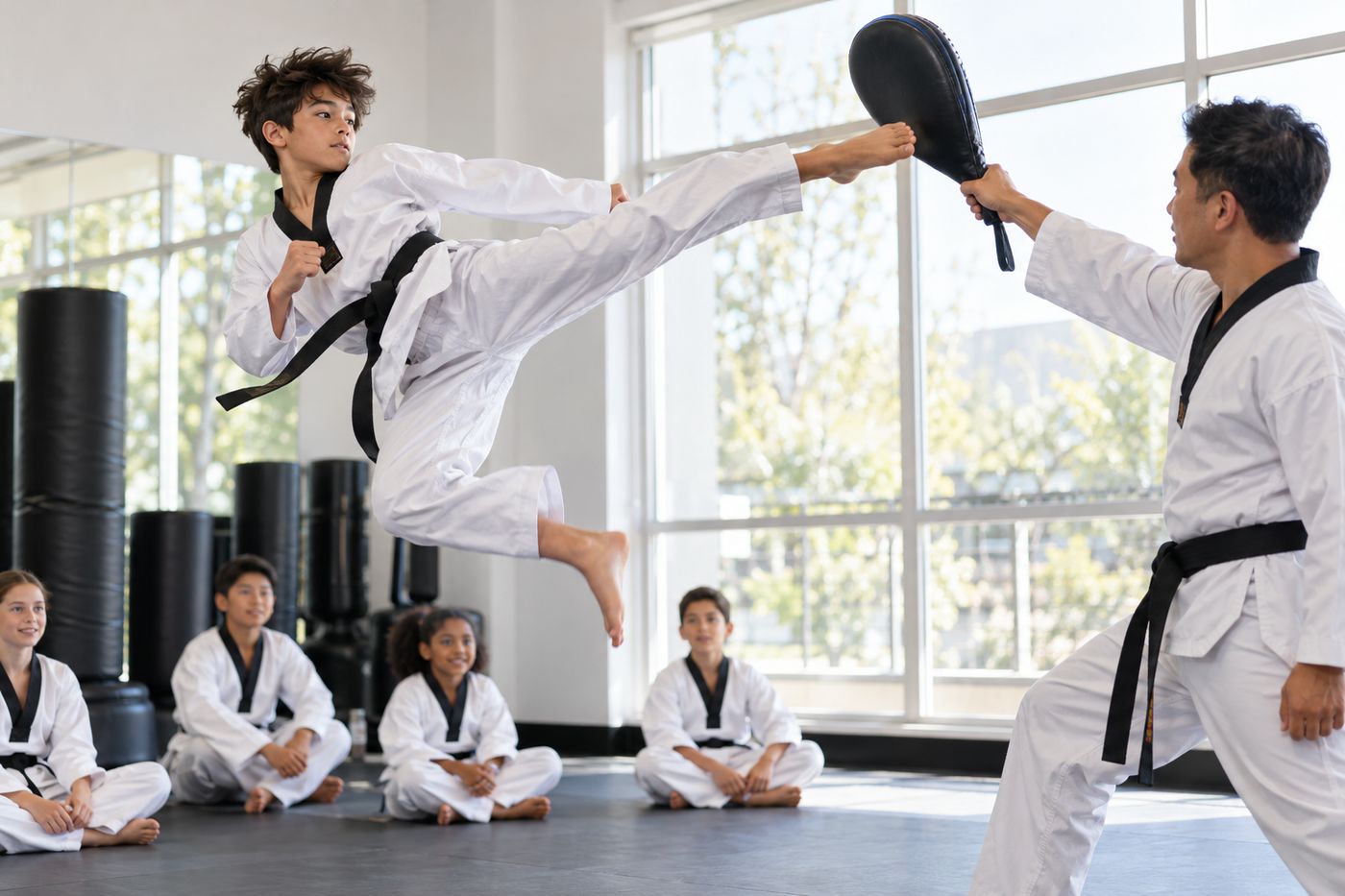
In Olympic sparring, a low, quick tornado kick is a turning kick to the body or head, which scores extra points when it lands. In breaking and demonstrations, a high, jumping tornado kick is used to break boards held above head height. It is also the stepping stone to the 540 kick and other advanced spinning kicks.
How to do a tornado kick, step by step
- Start in a fighting stance, side-on to the target, guard up.
- Turn your head and look over your back shoulder at the target.
- Step the back foot across in front of the front foot, or pivot on the front foot, to start the spin. Your back turns toward the target.
- Keep spinning and bring the front knee up, as if starting a front kick, to give you lift.
- Push off the floor and, as your body comes back round to face the target, throw a roundhouse kick with the back leg.
- Land on the non-kicking foot, then set the kicking foot down in your fighting stance.
The order of the turn is head, shoulders, hips, then legs. If the head leads, the rest follows.
Common mistakes
Kicking before the turn is finished is the most common error. The roundhouse should fire as you come back round to face the target, not while you are still facing away.
The second is jumping straight up without spinning. Height matters less than rotation. A low tornado kick with a full turn is better than a high jump that only turns halfway. Third, students often lose sight of the target during the spin. Spot it over your shoulder before you turn. Last, landing on the kicking leg leaves you off balance. The standing leg lands first.
Drills to practise at home
Step-through spins. Practise the step across and full spin without kicking, landing back in stance. Ten each way.
Low tornados. Do the full kick without jumping, staying on the floor and finishing with a roundhouse at waist height. Focus on rotation.
Knee lift spins. Spin and lift the front knee high without kicking, to feel how the knee drives the lift.
Target practice. Hang a towel at chest height and practise the kick slowly, then faster as it gets cleaner.
Practise spinning and jumping kicks on a mat or carpet with plenty of room around you, and stop if you get dizzy.
Where it fits in your training
Most students learn the tornado kick around brown or red belt, after the roundhouse and back kick are solid. The next step is the 540 kick. For every other kick, see our guide to Taekwondo kicks.
Questions parents and students ask
What is a tornado kick in Taekwondo?
A spinning roundhouse kick. The body turns a full circle, usually with a small jump, and the back leg finishes with a roundhouse kick. It is also called a 360 kick. The Korean name, dolgae chagi, means whirlwind kick.
Is a tornado kick a jumping kick?
Usually, but not always. In sparring it is often done low and fast, staying close to the floor. In demonstrations and breaking, it is thrown with a big jump for height.
What belt learns the tornado kick?
Most schools teach it around brown or red belt, once the roundhouse and back kick are solid. Some demonstration programs start it earlier.