On this page
Taekwondo classes around the world are taught in a mix of English and Korean. The instructor may explain a technique in English, but the commands, the counting and the names of kicks are usually Korean, just as ballet uses French. For a new student, or a parent listening from the lobby, that can sound like a wall of unfamiliar words. The good news is that the core vocabulary is small, and once you know the building blocks, the longer terms decode themselves.
Our full Korean terms glossary lists every word with a ▶ button that plays the pronunciation. This guide explains how the words fit together, so you understand them rather than just memorizing them.
How Taekwondo terms are built
Most technique names are made of two parts: a target or body part, and an action. Learn a handful of each and you can read most of the curriculum.
The actions are makgi (막기, block), jireugi (지르기, punch), chigi (치기, strike), chagi (차기, kick) and seogi (서기, stance). The levels are arae (아래, low), momtong (몸통, middle, literally “trunk”) and eolgul (얼굴, high, literally “face”). So arae makgi is a low block, momtong jireugi a middle punch, and eolgul makgi a high block.
Kicks work the same way. Ap (앞) means front, yeop (옆) means side, dwi (뒤) means back, and dollyeo (돌려) means turning. Put them in front of chagi and you get ap chagi (front kick), yeop chagi (side kick), dwi chagi (back kick) and dollyeo chagi (roundhouse kick). Add ttwieo (뛰어, jumping) at the start, and ttwieo ap chagi is a jumping front kick.
Class commands
These are the words you will hear in every class, usually at the start and end.
| Korean | Romanization | Meaning |
|---|---|---|
| 차렷 | charyeot | Attention |
| 경례 | gyeongnye | Bow |
| 준비 | junbi | Ready |
| 시작 | sijak | Begin |
| 그만 | geuman | Stop |
| 바로 | baro | Return to ready |
| 쉬어 | swieo | At ease |
| 기합 | gihap | The shout with a strike |
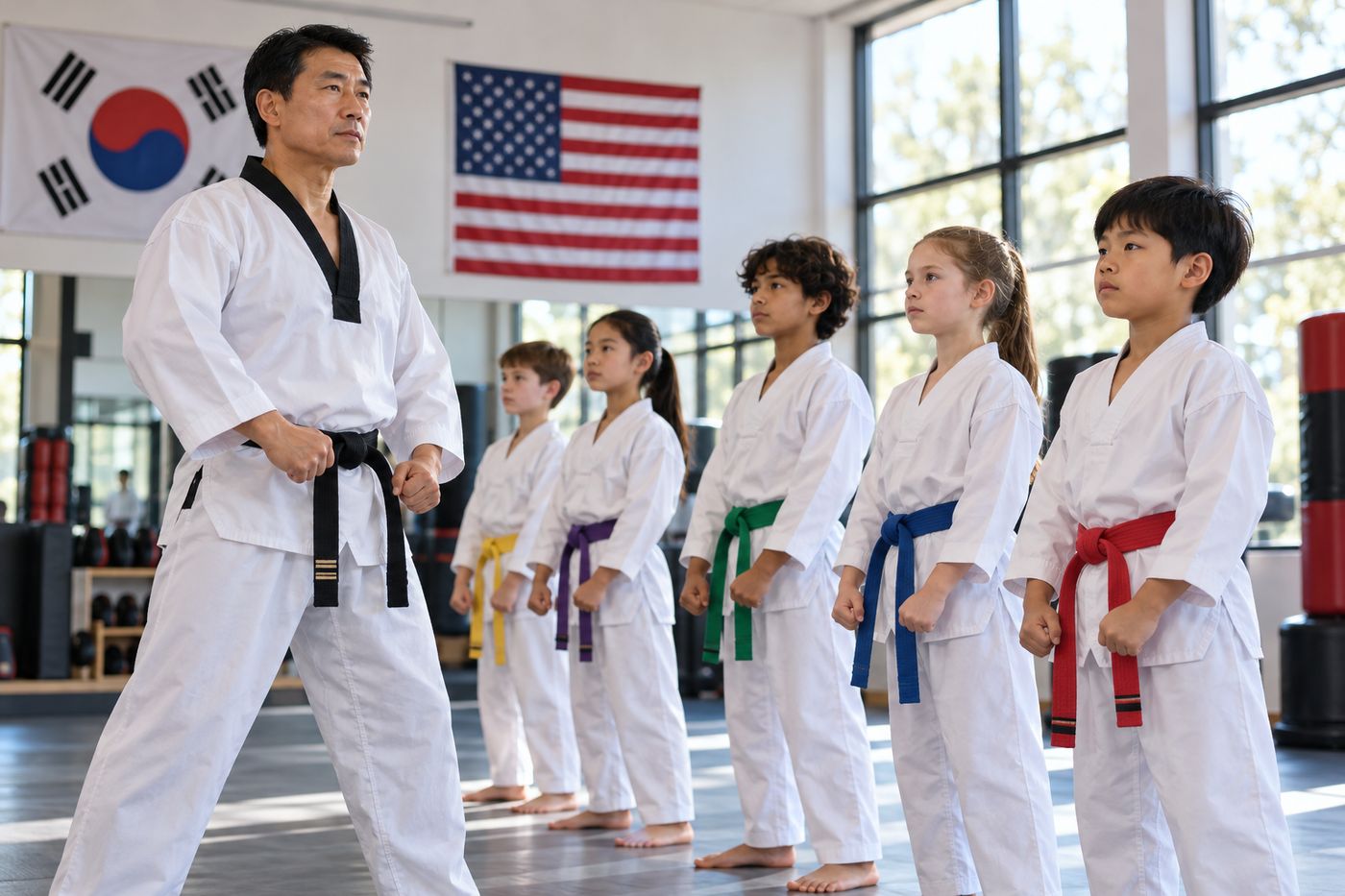
A typical class opening sounds like this: charyeot (everyone stands straight), gyeongnye (everyone bows to the instructor), junbi (everyone steps into ready stance), and then sijak to begin a drill. We explain each one in detail in Taekwondo class commands.
Counting
Taekwondo uses native Korean numbers for counting repetitions: hana, dul, set, net, daseot, yeoseot, ilgop, yeodeol, ahop, yeol. The names of the forms and the black belt degrees use a second set of numbers borrowed from Chinese, which is why the first form is Taegeuk Il Jang rather than Taegeuk Hana Jang. Our guide to counting in Korean for Taekwondo covers both sets and when each is used.
Stances
Seogi means stance, and every stance name ends with it. The most important for beginners are moa seogi (feet together), naranhi seogi (parallel stance, used for the ready position), apseogi (walking stance, a short natural step), apkubi (front stance, long and deep), dwitkubi (back stance) and juchum seogi (horse-riding stance). The Taegeuk forms switch between these constantly, so they are worth learning early.
People and places
The dojang (도장) is the training hall, the dobok (도복) is the uniform, and the tti (띠) is the belt. Instructors are addressed as sabeomnim (사범님), and the head of a school as gwanjangnim (관장님). Forms are poomsae (품새), sparring is gyeorugi (겨루기), breaking is gyeokpa (격파) and self-defense is hosinsul (호신술). Color-belt ranks are geup (급), black belt degrees are dan (단), and junior black belt degrees are poom (품).
Why spellings differ
You may see “kyorugi” on one school’s wall and “gyeorugi” on another’s, or “sabumnim” and “sabeomnim.” Both are attempts to write the same Korean sounds in English letters. Older materials use the McCune-Reischauer system, which was standard for decades, while newer materials follow the Revised Romanization that Korea adopted in 2000. Neither is wrong, and your instructor will understand either. In our guides we use the Revised Romanization and show common older spellings in the glossary.
Tips for remembering
Hearing a word is more useful than reading it. Play the audio in our glossary and repeat it out loud. Ask your child to quiz you, since children love catching parents out on a term. And notice the patterns: once you know that chagi is a kick and makgi a block, half of every new technique name is already familiar.
Questions parents and students ask
What does 'Taekwondo' mean in Korean?
Tae (태) means to kick or strike with the foot, kwon (권) means fist, and do (도) means way or path. Together: the way of the foot and fist.
Why are Taekwondo words spelled differently at different schools?
Korean has been romanized in several systems. Older spellings like 'kyorugi' and 'chagi' come from the McCune-Reischauer system, while 'gyeorugi' follows the official Revised Romanization used in Korea since 2000. Both are correct.
Do I need to learn Korean to do Taekwondo?
Only the class vocabulary, around 50 to 100 words. Most students pick them up naturally within a few months.