On this page
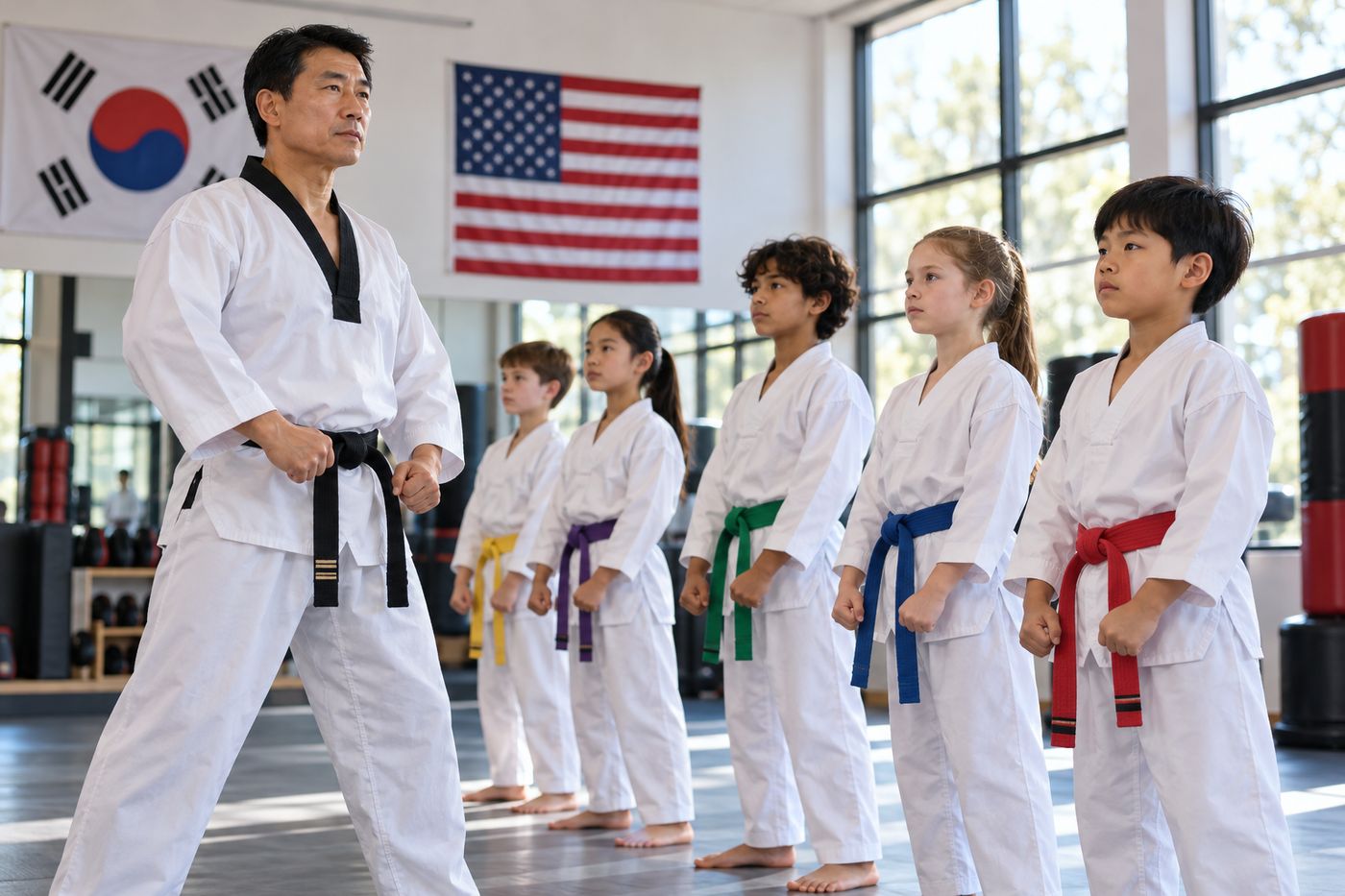
Counting in Korean is the first thing most Taekwondo students learn, and it comes up in every class. The instructor calls out the numbers while the class punches or kicks on each count, and before long students start counting themselves, often loudly. It is also the easiest piece of Korean for a parent to learn alongside their child.
One to ten
Taekwondo classes count repetitions with the native Korean numbers.
| Number | Korean | Romanization | Say it like |
|---|---|---|---|
| 1 | 하나 | hana | HAH-nah |
| 2 | 둘 | dul | dool |
| 3 | 셋 | set | set |
| 4 | 넷 | net | net |
| 5 | 다섯 | daseot | dah-SUHT |
| 6 | 여섯 | yeoseot | yuh-SUHT |
| 7 | 일곱 | ilgop | EEL-gohp |
| 8 | 여덟 | yeodeol | yuh-DUHL |
| 9 | 아홉 | ahop | ah-HOHP |
| 10 | 열 | yeol | yuhl |
Press the ▶ buttons at the top of this page to hear each one. A few sounds trip up English speakers. The “eo” in daseot and yeol is like the “u” in “cup,” not “ee-oh.” The final consonants in set, net, daseot and yeoseot are clipped short, almost swallowed, rather than fully pronounced. And yeodeol is often heard as “yuh-dul” because the final sound is soft.
How counting sounds in class
In class, counting has a rhythm. The instructor calls a number and the class responds with the technique, or the class calls the number together as they strike. Many schools have students count in unison from hana to yeol and finish the tenth repetition with a gihap, the sharp shout. You may also hear numbers stretched out for emphasis, like “haaa-na!”, which is normal and helps the class move together.
Some schools count only up to net (four) or yeodeol (eight) depending on the drill. When students line up by rank, they may number off: the first student calls hana, the next dul, and so on down the line.
The second set: numbers for forms and ranks
Korean has a second set of numbers, borrowed from Chinese centuries ago and called Sino-Korean numbers. They are used for dates, money, and, in Taekwondo, for the names of forms and black belt degrees.
| Number | Korean | Romanization | Where you’ll hear it |
|---|---|---|---|
| 1 | 일 | il | Taegeuk Il Jang, 1st dan (il dan) |
| 2 | 이 | i (ee) | Taegeuk Ee Jang, 2nd dan |
| 3 | 삼 | sam | Taegeuk Sam Jang |
| 4 | 사 | sa | Taegeuk Sa Jang |
| 5 | 오 | o (oh) | Taegeuk Oh Jang |
| 6 | 육 | yuk | Taegeuk Yuk Jang |
| 7 | 칠 | chil | Taegeuk Chil Jang |
| 8 | 팔 | pal | Taegeuk Pal Jang |
| 9 | 구 | gu | 9th dan |
| 10 | 십 | sip | 10th geup (sip geup) |
This is why the first form is called Taegeuk Il Jang (태극 1장), not Taegeuk Hana Jang. Jang means chapter, so Il Jang is “chapter one.” A first-degree black belt is il dan (일단), and a brand-new white belt is sip geup (십급), tenth grade.
Counting past ten
A few schools count higher, especially for push-ups. In native Korean, eleven is yeolhana (ten-one), twelve yeoldul, and so on up to nineteen, yeorahop. Twenty is seumul, thirty seoreun. If your school does fifty push-ups in Korean, you will learn these quickly.
Practicing at home
Counting is a natural game for children. Count stairs in Korean, count jumping jacks, or count down to bedtime. Ask your child to be the instructor and call out the numbers while you punch the air. Within a week, most families can count to ten without thinking, which makes the lobby feel a lot less foreign.
Questions parents and students ask
How do you count to 10 in Korean for Taekwondo?
Hana, dul, set, net, daseot, yeoseot, ilgop, yeodeol, ahop, yeol. These are the native Korean numbers used for counting repetitions in class.
Why is the first form called Il Jang and not Hana Jang?
Form names and black belt degrees use Sino-Korean numbers (il, i, sam, sa, o, yuk, chil, pal), a second number system borrowed from Chinese. Repetitions use native Korean numbers.
How do you count past ten in Korean?
Combine yeol (ten) with the next number: yeolhana is eleven, yeoldul twelve, and so on. Twenty is seumul.