On this page
The honest answer is “about three years,” followed by a lot of “it depends.” Most students at a typical American school who train two or three times a week earn a first-degree black belt somewhere between two and a half and four years after their first class. Some get there faster, many take longer, and a surprising number stop at red belt, which is worth knowing before you sign a long contract.
What moves a student along that range is less about talent than about three plain things: how often they train, how often the school tests, and how demanding the black belt test is. Once you understand those, you can look at any school’s promise and tell whether it is realistic.
The typical timeline, belt by belt
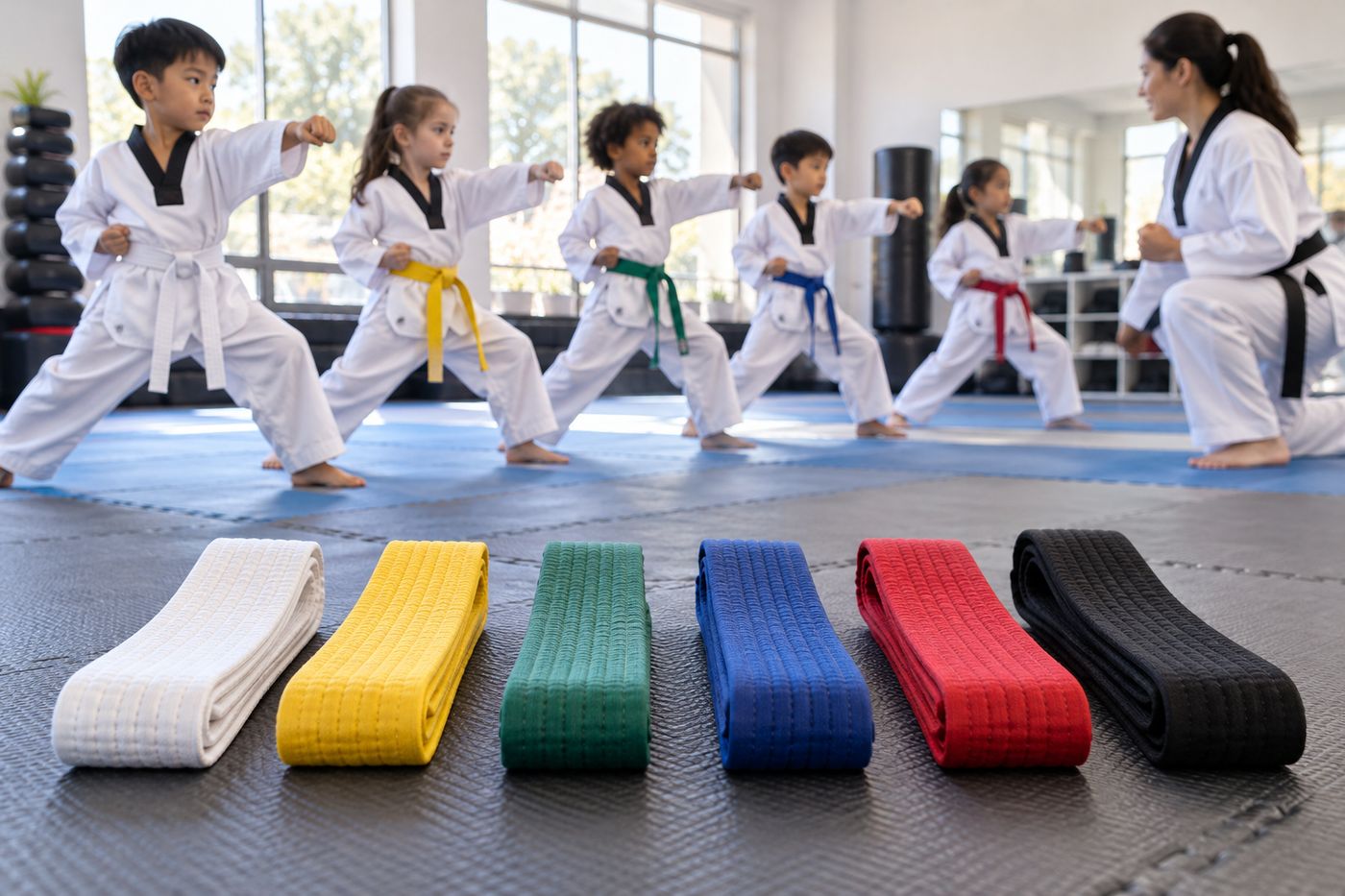
Most schools test color belts every two to four months. The first few promotions come quickly because the material is simple: bowing, stances, a low block, a front kick, and the first form, Taegeuk Il Jang. A child can go from white to yellow belt in eight to twelve weeks.
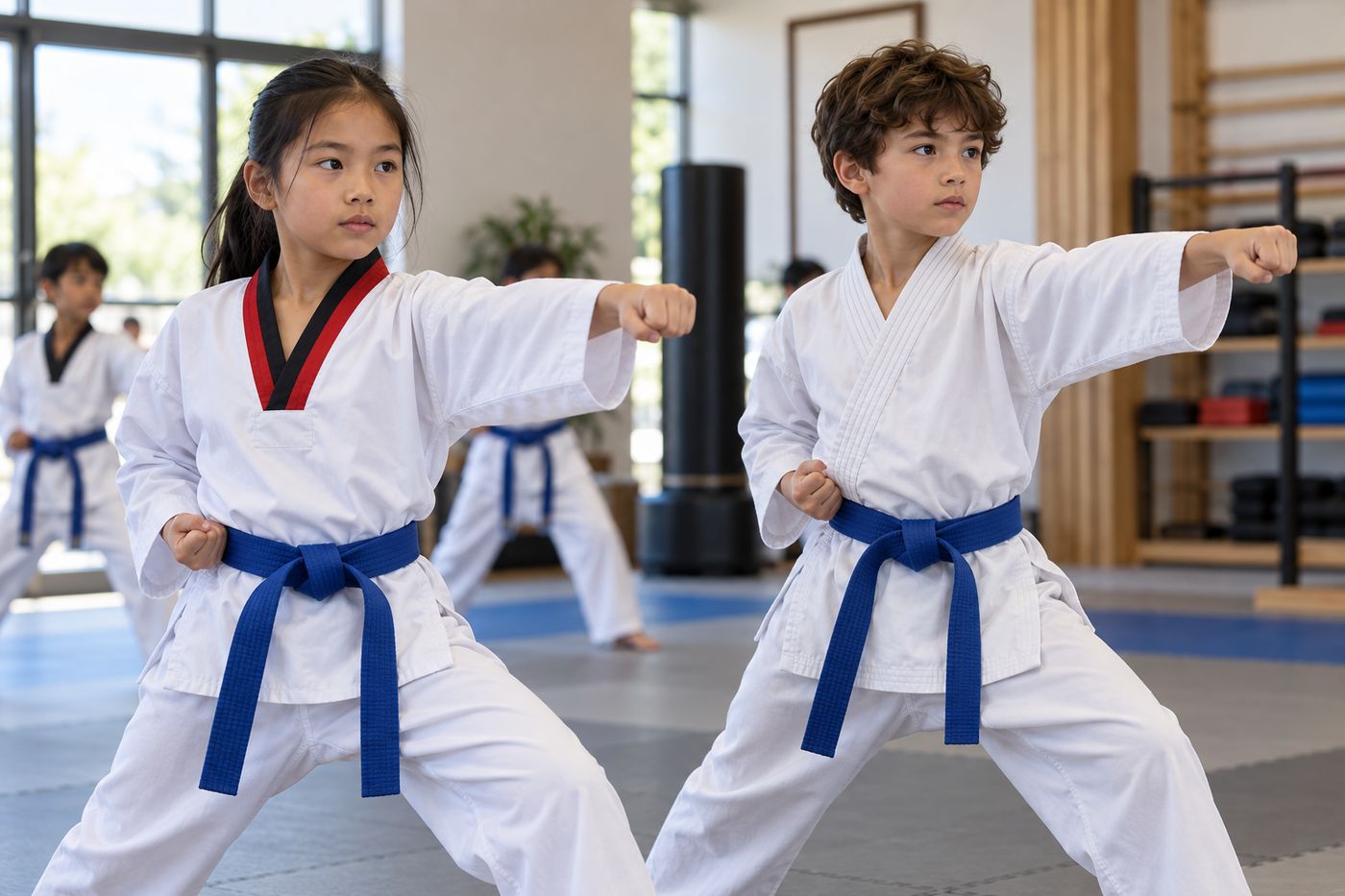
The middle belts slow down. Green and blue belts bring longer forms, new kicks like the side kick and back kick, and the start of real sparring, so three to six months per belt is normal. Red belt is usually the longest stop on the ladder. Students at red belt are learning the last two Taegeuk forms and preparing for a test that pulls everything together, and schools commonly ask for six months to a year at this rank before they allow a black belt attempt.
Add those stages up and a student who never misses a test lands at roughly two and a half years, while a student who misses a test or two, takes a summer off or changes schools ends up nearer four.
Why kids in Korea seem to get there faster
Parents who read about Korean children earning a black belt in a year are not imagining it. In Korea, many children attend the dojang every weekday, often for an hour after school, and schools test monthly. A child who trains five days a week for a year has spent roughly the same number of hours on the mat as an American child who trains twice a week for two and a half years. The hours line up even when the calendar does not.
Korean schools also award most children a poom rank rather than a dan rank. A poom is a junior black belt for students under 15, and it converts to the matching dan when the student turns 15. That system lets young children reach a black belt goal earlier, while the adult rank waits until they are older.
How training frequency changes the answer
If you want a quick estimate for your own child or yourself, count hours rather than months. A rough guide many instructors use is that a first-degree black belt takes somewhere between 300 and 500 hours of class time.
| Classes per week | Hours per year (approx.) | Typical time to black belt |
|---|---|---|
| 1 | 45 | 6 years or more |
| 2 | 90 | 3.5 to 5 years |
| 3 | 135 | 2.5 to 3.5 years |
| 5 | 220 | 1.5 to 2 years |
These figures assume roughly one-hour classes and normal holidays, and they are only a starting point. A student who practices forms at home for ten minutes a day often passes tests on the first try, which keeps them on the faster end of each range.
What the black belt test asks for
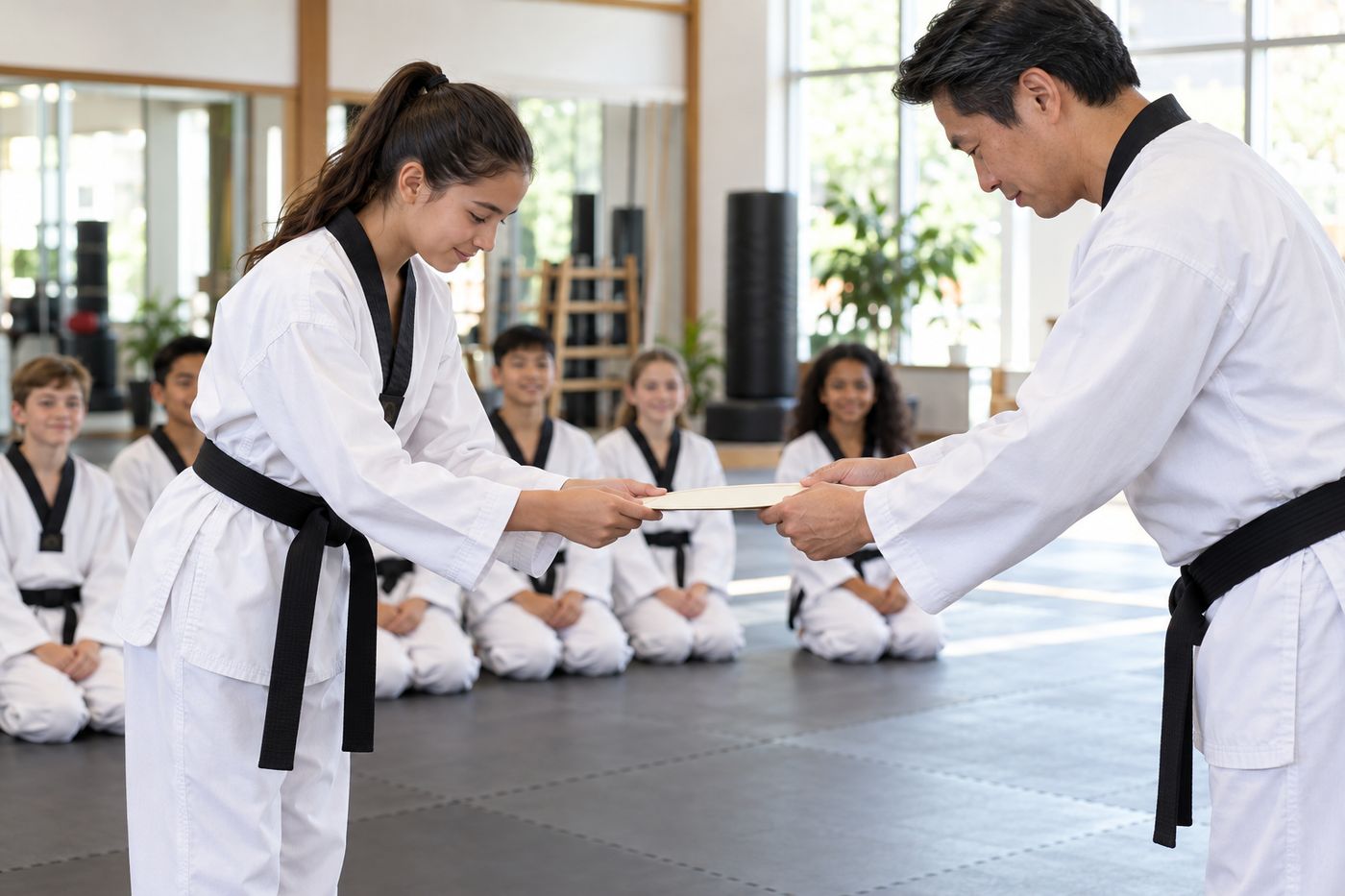
A black belt test, called seungdan simsa (승단 심사) in Korean, is longer and stricter than a color-belt test. At an Olympic-style school it almost always includes all eight Taegeuk forms performed on demand, often with the examiners calling out a form at random, plus Koryo at some schools. There will be basic techniques and combinations, several rounds of sparring, board breaking with hand and foot techniques, and questions on Korean terms and the school’s history. Many schools also ask for an essay on what Taekwondo means to the student, and some add a fitness section with push-ups, sit-ups or a timed run.
Most schools run a “pre-test” a few weeks before the real one, so a student who is not ready hears that privately rather than failing in front of family. If your child is told to wait another cycle, that is normal and usually means the school’s standard is real.
Adults: slower legs, faster heads
Adults tend to learn forms and terminology faster than children, because they can study on their own and remember sequences more easily. Where they lose time is flexibility and recovery. High kicks need hip mobility that many adults have not used in decades, and a sore hamstring can cost a week of class. Adults who stretch a little every day and train two or three times a week usually reach black belt in three to five years, the same range as children. Our guide to starting Taekwondo as an adult covers how to stay on track.
Red flags and green flags in a school’s timeline
A school that guarantees a black belt in a fixed time, regardless of attendance, is selling a product rather than teaching a skill. Watch for “black belt club” contracts that bundle every test fee into a two- or three-year payment plan with a promise of black belt at the end. They are not always bad value, but a guarantee of rank is a warning sign.
On the other side, a school that cannot tell you its requirements for each belt, or that keeps students at one belt for a year without explaining why, is also worth questioning. Good schools publish a curriculum sheet, test on a regular schedule, and will tell you what your child needs to work on before the next test.
After the first black belt
The first black belt is the start of a new ladder, and the gaps get longer. The Kukkiwon sets minimum waiting periods between degrees: at least one year from 1st to 2nd dan, two years from 2nd to 3rd, three years from 3rd to 4th, and longer intervals at each step after that. Each degree comes with a new form, starting with Koryo for 2nd dan and Keumgang for 3rd. By 4th dan a practitioner has usually trained for at least a decade, and it is the rank at which many people start teaching as a master, or sabeomnim.
For most families, though, the first black belt is the big moment, and three years of steady training is the number to plan around.
Questions parents and students ask
Can you get a black belt in Taekwondo in one year?
It is possible at schools that train daily and test every month, which is common in Korea, but most American schools take two and a half to four years. A one-year black belt in the US usually means very frequent classes or a school with a light test.
How long does it take an adult to get a black belt in Taekwondo?
Adults who train two or three times a week typically reach black belt in three to five years. Adults often learn forms faster than children but take longer on flexibility and kicks.
What is the youngest age for a Taekwondo black belt?
The Kukkiwon does not issue dan ranks under 15. Younger students earn a poom black belt, and many schools set their own minimum age for the black belt test, often seven or eight.
How long from 1st dan to 2nd dan?
The Kukkiwon requires at least one year between 1st and 2nd dan, two years between 2nd and 3rd, and longer gaps at each higher degree.