On this page
Sparring, called gyeorugi (겨루기) in Korean, is the part of Taekwondo that most looks like a sport, and it is often the part that worries parents most. In practice, school sparring is controlled, padded and closely supervised, and it teaches timing, distance and composure in a way that forms alone can’t. Understanding how it is scored makes watching a match far more fun, too.
How a match works
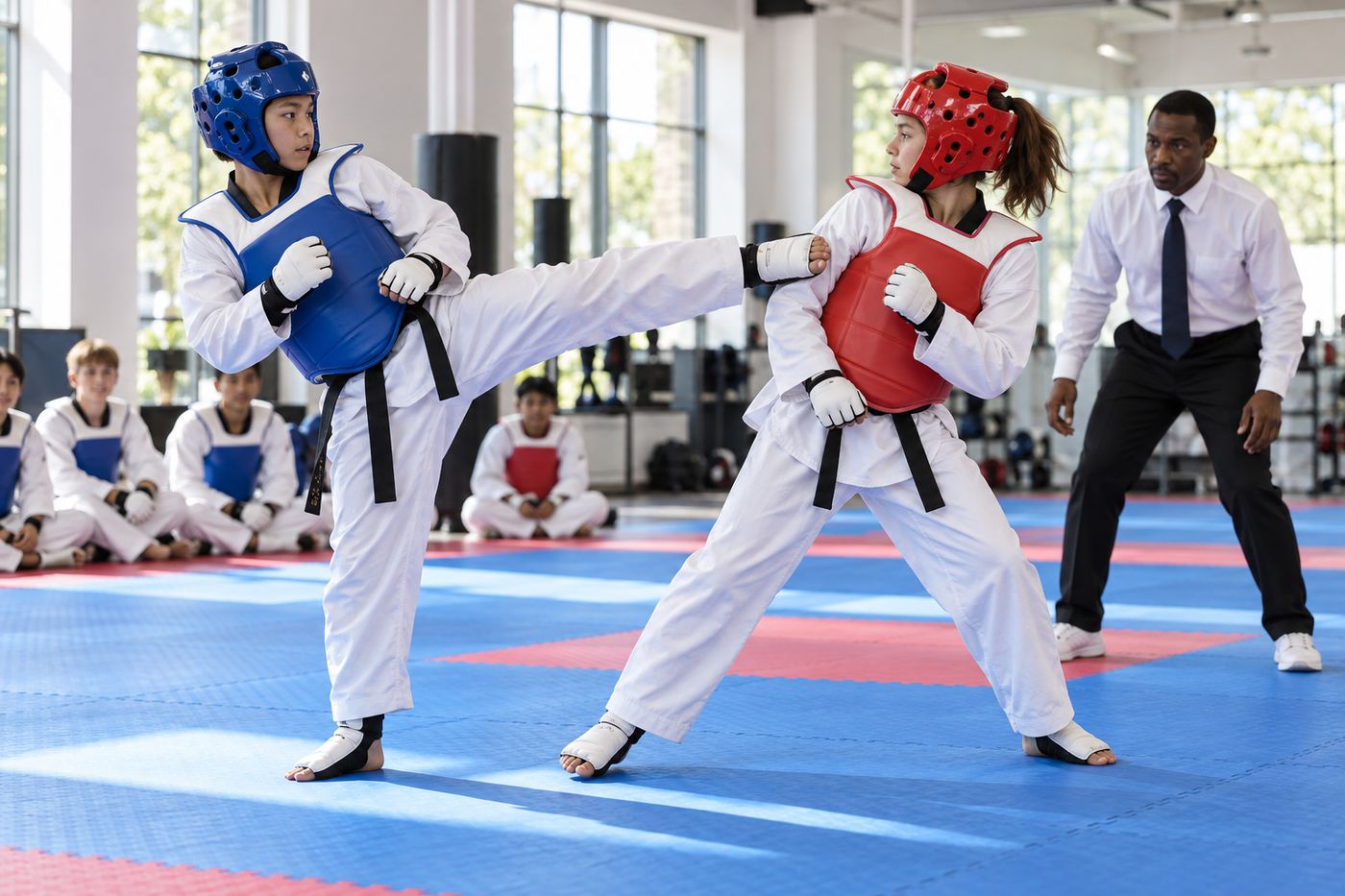
Olympic-style matches follow World Taekwondo’s competition rules. Two competitors, one in the cheong (blue) corner and one in the hong (red) corner, fight in an octagonal or square ring. Senior matches are usually decided as the best of three rounds, each two minutes long, with a short rest between them. Winning two rounds wins the match. Local tournaments for children often use shorter rounds and simplified formats.
The referee starts each round with sijak (begin), separates fighters with gallyeo (separate), and restarts with gyesok (continue). At the end, the referee raises the winner’s hand.
What scores a point
At most competitions today, scoring is electronic. Fighters wear a chest protector and headgear fitted with sensors, plus socks with magnetic patches, so a kick that lands with enough force registers automatically. Judges at ringside add points for punches and for the bonus on turning kicks.
| Technique | Points |
|---|---|
| Punch to the chest protector | 1 |
| Kick to the chest protector | 2 |
| Turning kick to the chest protector | 4 |
| Kick to the head | 3 |
| Turning kick to the head | 5 |
| Penalty (gam-jeom) against the opponent | 1 |
Punches are allowed only to the body protector, never the face. Kicks can target the body protector and the head, but not below the waist. A “turning kick” means a kick where the fighter spins their back toward the opponent, such as a back kick or spinning hook kick, which is why you will see so many of them in high-level matches.
Common penalties
A gamjeom (감점) is a penalty that awards one point to the opponent. Common reasons include stepping out of the ring, falling down, grabbing or holding the opponent, kicking below the waist, lifting a leg to block kicks without attacking, attacking after the referee says stop, and avoiding the fight by turning away. Collect too many and the referee can award the round, or the match, to the opponent.
How kids’ sparring is different
Children’s sparring at a school is far gentler than what you see on television. Most schools start with drills, then “touch” or light sparring where students practice landing techniques with control. Contact increases slowly as students show they can manage it. In competition, many organizations limit or forbid head kicks for younger age groups, and referees stop matches quickly if a child is outmatched. If your child is nervous, ask the instructor to pair them with someone gentle for the first few rounds.
Gear to buy, in order
Your school will tell you exactly what it requires, and it is worth asking before buying, since many schools insist on one brand or color. Most beginners need the following, roughly in the order they matter:
- Mouthguard. Cheap, essential and the first thing to buy.
- Groin guard for boys and men, and a chest guard for women if the school recommends one.
- Chest protector (hogu). Many schools lend these at first. Sizes are numbered, so try one on.
- Headgear. Must fit snugly without blocking vision. Most children’s headgear has a face shield option.
- Forearm and shin guards. Light foam guards that slip on.
- Hand and foot protectors. Thin padded gloves and instep covers.
A full set for a child usually costs $100 to $250. Electronic sensor socks and chest protectors are only needed for competitions that use them, and the tournament often supplies the protectors.
Making sparring a good experience
The students who enjoy sparring most are usually the ones who learned it slowly, with good partners and clear rules. At home, you can help by keeping gear clean and dry, since a damp chest protector smells quickly, and by asking your child what they tried, not whether they won. Sparring is a skill like any other, and most young fighters lose many rounds on the way to understanding it.
Questions parents and students ask
How do you score points in Taekwondo sparring?
Under World Taekwondo rules, a punch to the chest protector scores 1 point, a kick to the body 2, a kick to the head 3, and extra points are added for turning kicks: 4 to the body and 5 to the head. Penalties give the opponent 1 point.
Is punching to the face allowed in Taekwondo?
No. In Olympic-style Taekwondo, punches are only allowed to the chest protector. Kicks may target the body protector and the head.
What sparring gear does a beginner need?
A chest protector (hogu), headgear, forearm and shin guards, hand and foot protectors, a mouthguard, and a groin guard. Check your school's required brand and color before buying.
When do kids start sparring in Taekwondo?
Most schools start light, controlled sparring at yellow or green belt, after students have learned basic kicks and control.